
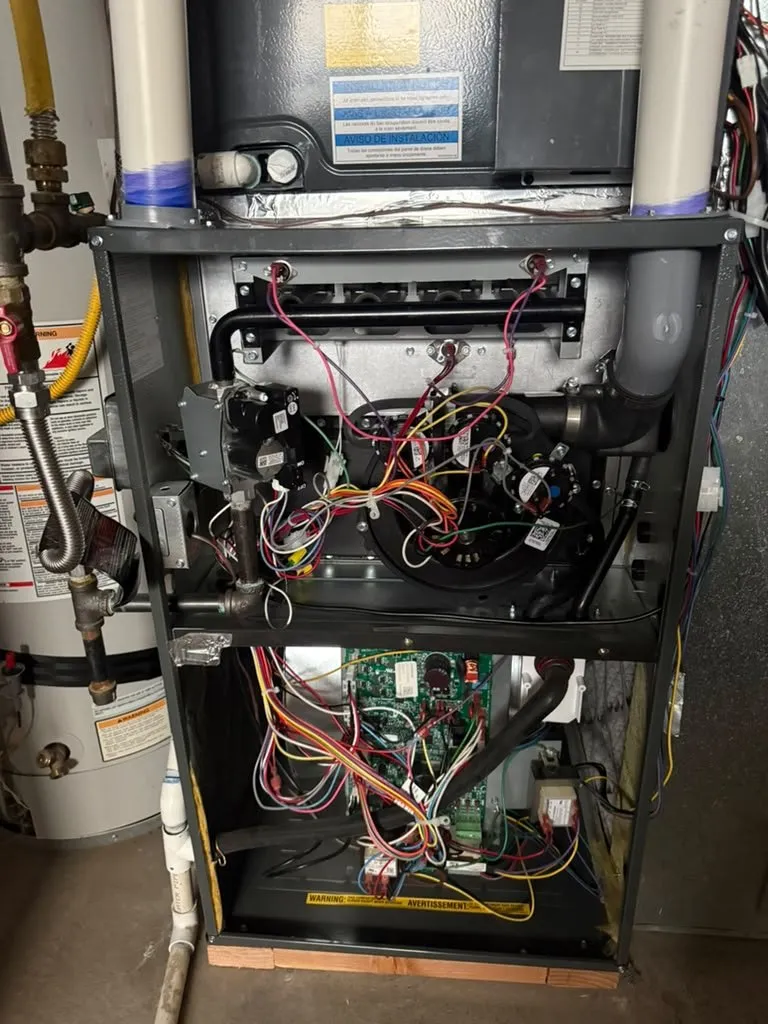
Every furnace makes some noise. The first cold nights of the year are when you notice it, because the house is quiet and the furnace is running for the first time in months. Most of what you hear is normal. A few sounds mean a part is wearing out, and two mean you should turn the furnace off and call.
Here is a plain guide to what each sound usually means, so you know which is which.
One rule before anything else. If you smell gas, leave the house first and call Enbridge Gas (formerly Dominion Energy) at 1-800-767-1689, or 911, from outside. If a carbon monoxide detector goes off, do the same. Our carbon monoxide and furnace safety guide covers the warning signs.
Normal sounds
A healthy furnace starts in a sequence you can learn to hear:
- A click at the thermostat or the furnace when it calls for heat.
- A hum as the inducer motor starts to clear the exhaust.
- A clicking or ticking from the igniter for a few seconds.
- A soft whoosh as the burners light.
- The blower coming on a little later and running steadily.
Ticking or popping in the ducts as they warm up and cool down is also normal. Metal ducts expand with heat, and the sound usually fades after the first few minutes of a cycle.
And the first time the furnace runs in the fall, a burning-dust smell for a few minutes is normal too. Our first freeze furnace checklist explains the difference between that and a smell that is not.
Sounds that need a repair soon
Squealing or screeching. A high squeal usually comes from the blower: a motor bearing that is wearing out, or a worn belt on an older furnace. It tends to get louder, and a blower motor that seizes means no heat. Worth a visit before it fails.
Rattling. A rattle can be as simple as a loose panel door or a screw that worked loose. It can also be a loose part in the blower or the inducer motor. Check that the panel door is seated. If the rattle is coming from inside the cabinet, have it looked at.
Repeated clicking with no flame. If the igniter clicks and clicks but the burners never light, or light and go out right away, the furnace is trying and failing to start. It is often the igniter or a dirty flame sensor, and after a few tries most furnaces lock out completely. Our furnace won’t turn on checklist covers what to check first.
Whistling. A whistle at the furnace or the vents usually means the furnace is starved for air: a clogged filter, or closed registers and blocked returns. Replace the filter and open the vents. If the whistle stays, the ductwork may be undersized or leaking.
Loud humming or buzzing from the cabinet. A steady hum is normal. A loud buzz can be a motor struggling to start or an electrical part on its way out. It is worth a look before it stops.
Turn it off and call
A boom or bang when the burners light. This is often delayed ignition: gas builds up for a moment before it lights, then lights all at once. It is usually caused by dirty burners or a weak igniter, and every bang is hard on the heat exchanger. Turn the furnace off at the thermostat and call. Do not keep running it to see if it happens again.
Grinding or metal scraping. That is usually a failing blower motor bearing or a blower wheel that has come loose and is rubbing the housing. Turn it off. Running it can turn a motor repair into a bigger one.
A noise is a clue, not a verdict
A noise tells you where to look, not what it costs. A squeal can be a belt, or it can be a motor. A rattle can be a screw. If anyone tells you a noise means the furnace has to be replaced and cannot show you why, get a free second opinion before you sign anything.
What it costs to find out
Our furnace repair diagnostic is a flat $69, and it is waived if we do the repair. All makes and models, whether or not we installed it, and we tell you what we found before we fix anything. When you call, tell us when the noise happens: at start-up, while it runs, or when it shuts off. That one detail narrows it down.
A $120 tune-up in the fall catches most of the parts on this list, the burners, the flame sensor, and the blower, before they start making noise. And if the furnace is old and the repair is a big one, our guide to repairing or replacing a furnace explains how we decide, with both options in writing.
Hearing something new from the furnace? Call or text (801) 678-5748, Monday through Friday, 8 AM to 8 PM, in English or Spanish.